



 Home /
 Single vs Double Acting Pneumatic Actuators Torque and Uses
Explore Single Acting vs Double Acting Pneumatic Actuators differences torque applications selection tips
What is a Pneumatic Actuator?
A pneumatic actuator serves as the “muscle” of valve automation systems. Unlike electric actuators that rely on motors and gears, pneumatic devices convert the energy from compressed air into mechanical motion to open, close, or modulate valves. They are renowned for their high torque-to-weight ratio, offering a compact yet powerful solution for controlling flow in industrial pipelines. At Delco Valves, we engineer these devices to provide robust automation for everything from simple water lines to complex chemical processing, focusing on reliability and speed.
How Pneumatic Actuators Work
Pneumatic actuators operate using compressed air, typically supplied at pressures between 4 and 8 bar (60–115 PSI). When compressed air enters the actuator chamber, it drives internal pistons. This linear force is then converted into rotary torque—essential for operating quarter-turn valves like ball and butterfly valves.
Our product lines utilize two primary mechanisms to achieve this:
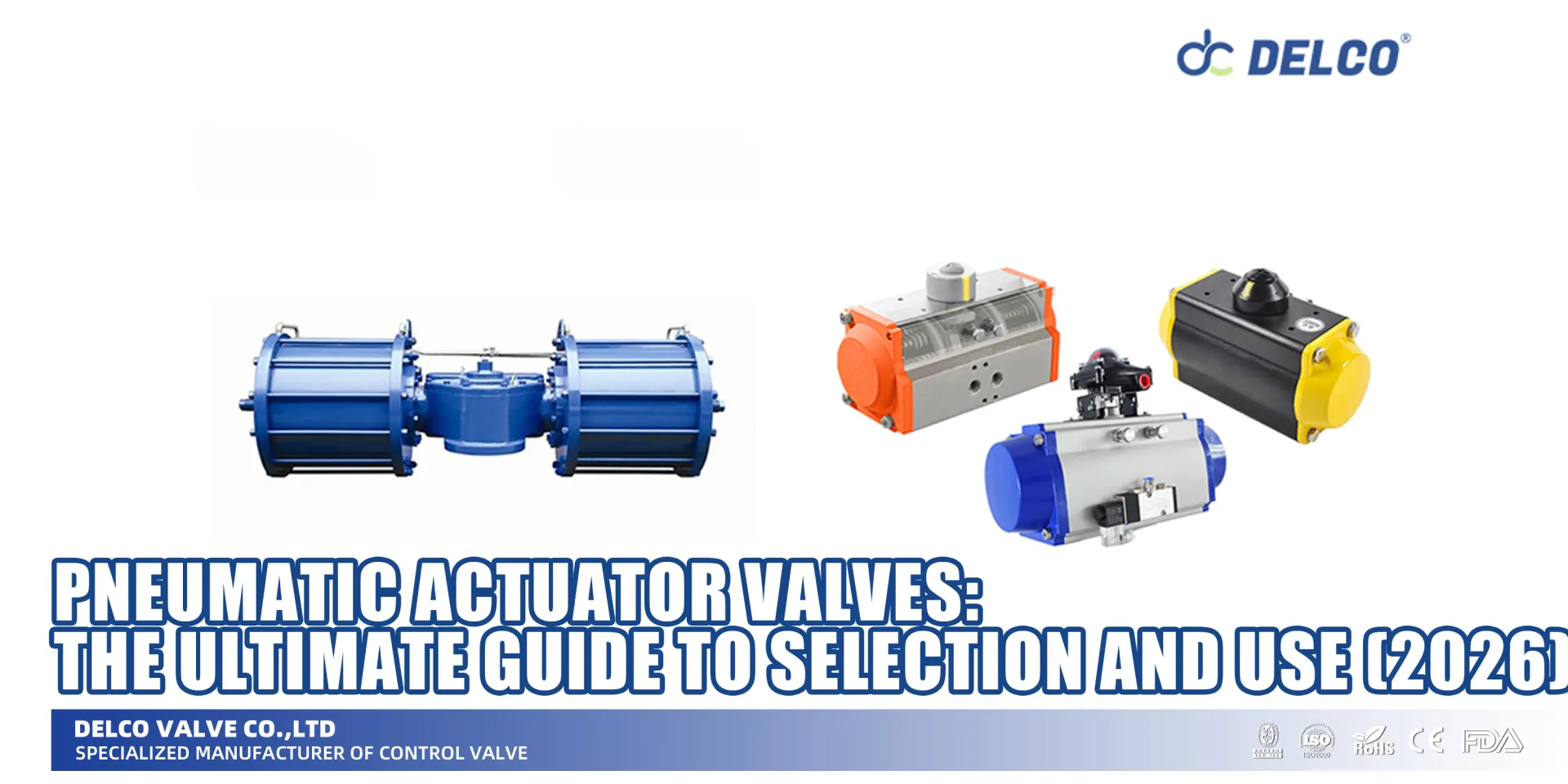
- AT Rack and Pinion Pneumatic Actuators: Ideal for high-cycle applications, this design uses a linear rack to drive a rotating pinion gear, delivering consistent torque output in a compact design.
- AW Scotch Yoke Pneumatic Actuators: Designed for heavy-duty applications, this mechanism provides higher torque at the beginning and end of the stroke, making it ideal for overcoming valve breakaway torque in larger valves.
Common Industrial Applications
Because pneumatic actuators operate without electricity, they are intrinsically safe and spark-free. This characteristic makes them the industry standard for hazardous environments where safety is non-negotiable.
Key sectors relying on this technology include:
- Oil & Gas: Utilized for Emergency Shutdown (ESD) systems where fail-safe mechanical certainty is required.
- Chemical Processing: Essential for explosive zones where electric sparks could be catastrophic.
- Water Treatment: Preferred for their durability and ability to handle high-frequency cycling in slurry and water lines.
- Power Generation: Used for precise damper and steam valve control.
<h2>Single Acting Pneumatic Actuators (Spring Return)</h2>
Often referred to as a spring return actuator, the single acting pneumatic actuator is the go-to choice for systems where safety and reliability are non-negotiable. Unlike its double-acting counterpart, this design relies on a combination of compressed air and mechanical energy to manage valve positioning.
How Single Acting Actuators Operate
The operation is straightforward but highly effective. To open (or close) the valve, air supply pressure enters a single port, pushing the internal piston or diaphragm against a heavy-duty spring.
- Inbound Stroke: Compressed air overcomes the spring force to move the rack and pinion actuator or **scotchscotch yoke actuator mechanism.
- Outbound Stroke: When the air supply is cut or lost, the spring takes over, automatically forcing the piston back to its original “home” position.
Advantages of Single Acting Actuators
For most industrial operators, the primary draw of a single acting system is the **failfail safe design. It ensures that if power or air pressure fails, the valve defaults to a known safe state (either fully open or fully closed).
- **ReliableReliable Safety: Automatic return without needing a secondary air signal or backup power.
- Reduced Air Consumption: Since air is only used for one direction of the stroke, you significantly cut down on compressed air costs over time.
- Simplified Control: Requires only a 3-way solenoid valve and a single air line, making the plumbing much easier to manage.
- Ideal for Critical Valves: Perfect for ball valve actuators or butterfly valve actuators in hazardous environments where manual intervention is impossible during a shutdown.
Disadvantages and Limitations
While highly reliable, single acting units do come with specific trade-offs that need to be weighed against your system’s needs:
- Reduced Torque Output: Because the air pressure must fight against the spring during the active stroke, the effective torque output is lower than a double-acting unit of the same size.
- Physical Size: To accommodate the internal spring, these actuators are typically longer and heavier, which can be a challenge in tight piping layouts.
- Higher Initial Cost: The complexity of the spring mechanism generally makes these more expensive upfront compared to double-acting models.
- Spring Fatigue: Over millions of cycles, the mechanical spring can wear down, eventually requiring maintenance to ensure the fail-safe remains functional.
Double Acting Pneumatic Actuators
In my experience, the double acting actuator is the most versatile choice for standard industrial automation. These units are built for performance, offering a reliable solution for those who need active control over both the opening and closing of their valves.
How Double Acting Actuators Operate
The mechanism is simple but powerful. A double acting pneumatic actuator utilizes two internal air ports. To move the valve, air supply pressure is directed into the first port, pushing the piston or vanes to open the valve. To close it, the air is redirected to the second port. Whether you are using a rack and pinion actuator or a scotch yoke actuator, this design relies entirely on compressed air for every movement rather than mechanical force.
Advantages of Double Acting Actuators
I prefer these for high-demand systems where precision and size matter. Here is why they stand out:
- Higher Torque Output: Since the unit doesn’t have to fight against a spring, it delivers a more consistent and higher torque output throughout the entire stroke.
- Compact Footprint: These units are generally smaller than spring-return models, making them the perfect ball valve actuator or butterfly valve actuator for tight spaces.
- Cost-Effective: For most standard applications, the initial purchase price is lower because the internal construction is less complex.
- Durability: Fewer mechanical components mean less chance of part failure over millions of cycles.
Disadvantages and Limitations
Before choosing this model for your pneumatic valve actuator setup, keep these factors in mind:
- Lack of Fail-Safe: If your facility loses air pressure, a double acting unit will simply stop in its current position. It will not automatically return to a “safe” state.
- Higher Operating Costs: You use compressed air for both the opening and closing strokes, which can lead to higher energy consumption over time.
- Complex Controls: These require a more advanced 4-way solenoid valve to manage the dual air paths, adding a layer of complexity to your plumbing.
This type of actuator is best suited for any quarter turn valve where the air supply is stable and a mechanical fail-safe isn’t a strict safety requirement.
Single Acting vs. Double Acting Pneumatic Actuators: Key Differences
Choosing between a spring return actuator and a double acting actuator depends on how you need your pneumatic valve actuator to behave during both normal operation and power loss. While both are common in quarter turn valve setups, their internal mechanics dictate different performance outcomes.
Design and Operating Mechanism
The fundamental difference lies in how the piston returns to its original position. A double acting actuator uses air supply pressure to both open and close the valve. In contrast, a single acting actuator uses air to move in one direction and a built-in spring to push it back.
| Feature | Single Acting (Spring Return) | Double Acting |
|---|---|---|
| Air Ports | One (Inlet) | Two (Open/Close) |
| Return Method | Mechanical Spring | Compressed Air |
| Mechanism Type | Rack and pinion or Scotch yoke | Rack and pinion or Scotch yoke |
| Fail-Safe | Automatically closes or opens | Stays in last position |
Force Output and Speed
When it comes to torque output, the double acting actuator provides a constant force throughout the entire stroke because it isn’t fighting a spring.
- Double Acting: Offers higher, more consistent torque. Ideal for heavy-duty butterfly valve actuator or ball valve actuator needs where high breakaway torque is required in both directions.
- Single Acting: The torque output decreases as the spring compresses. You must size these carefully to ensure the air supply pressure can overcome the spring, and the spring can overcome the process fluid.
- Speed: Double acting units generally cycle faster because they don’t have the mechanical resistance of a spring.
Air Consumption and Energy Efficiency
If your facility prioritizes energy costs, the volume of air used per cycle is a major factor.
- Air Consumption: A single acting actuator is significantly more efficient, using roughly 50% less compressed air per full cycle since air is only used for one stroke.
- Operating Costs: While the initial cost of a spring return actuator might be higher due to the spring components, the long-term energy savings on your compressor system can be substantial.
- Application Fit: We recommend double acting for high-cycling applications where speed is king, and single acting where a fail safe design is the top priority for plant safety.
How to Choose Between Single and Double Acting Actuators
When we help partners decide between single acting vs. double acting pneumatic actuators, we focus on three main pillars: safety, torque requirements, and budget. ### Assessing Your Application Requirements
First, look at your valve type. For a quarter turn valve like a ball valve actuator or butterfly valve actuator, you must match the required torque for the entire stroke. Double acting units provide a constant torque output in both directions, making them ideal for high-frequency cycling. Single acting units, however, must overcome spring resistance, meaning you often need a larger actuator size to achieve the same operational force.
Fail-Safe Requirements and Safety
Safety is the most critical factor in your selection. If your facility loses air pressure or electricity unexpectedly, your actuator’s “fail” state determines the outcome:
- Single Acting (Spring Return): These feature a built-in fail-safe design. The internal spring automatically forces the valve to a predetermined safe state (either “Fail Closed” or “Fail Open”) without needing external power.
- Double Acting: These typically “fail in last position.” If the air supply vanishes, the valve stays exactly where it is. If a frozen valve creates a risk of tank overflow or pressure buildup, a double acting setup is a safety hazard.
Cost and Maintenance Considerations
We analyze the long-term value by comparing initial investment against operational needs:
| Selection Factor | Double Acting Actuator | Single Acting (Spring Return) |
|---|---|---|
| Purchase Price | Budget-friendly and accessible | Higher due to precision springs |
| Air Consumption | Higher (uses air for every move) | Lower (uses air for one direction) |
| Size & Weight | Compact and easy to install | Bulkier and heavier |
| Maintenance | Simple O-ring/seal kits | Requires monitoring for spring fatigue |
We generally recommend double acting actuators for standard industrial tasks where the “fail-in-place” logic is acceptable, as they are more cost-effective and take up less space. We only specify single acting units when the application demands a mechanical safety backup to protect equipment and personnel.
Frequently Asked Questions (FAQs)
Which type of pneumatic actuator is more cost-effective?
In my experience, choosing the most cost-effective option depends on whether you are looking at the upfront price or long-term operating costs.
- Initial Investment: Double acting actuators are generally cheaper to buy. They have a simpler internal design because they don’t require the high-tension springs found in spring return models.
- Operating Costs: Single acting pneumatic actuators can be more economical over time. Since they only use compressed air for one direction of the stroke, they significantly reduce air consumption.
- Safety Value: If your application requires a fail-safe design, a single acting unit is a “one-and-done” investment. Avoiding the cost of complex external safety systems often makes the single acting version the smarter financial choice for critical quarter turn valve setups.
Can a double acting actuator be used as a single acting one?
Technically, you cannot simply “convert” a standard double acting actuator into a true spring return actuator without replacing the internal hardware. A double acting unit lacks the dedicated chamber and mechanical spring needed to force the piston back to its original position without air.
While some engineers use external air reservoirs or specific 3-way valve plumbing to mimic a single-acting “return” movement, I don’t recommend it for safety-critical tasks. If you need a reliable Pneumatic Ball Valve or Pneumatic Butterfly Valve to close automatically during a power failure, a dedicated single acting model is the only way to ensure the torque output is sufficient to overcome line pressure without a constant air supply pressure.
Share on Social:


